Problem
Aggregate accuracy alone does not tell a quality team which defect classes fail most often or which uncertain cases should be reviewed first.
selected case study
A steel-defect classification case study using 1,800 NEU-CLS images, handcrafted visual features, model benchmarking, error analysis, and an entropy-ranked review queue, extended with a measured embedding-RAG assistant and a live 3D digital twin of the inspection line.
Quick technical review
Aggregate accuracy alone does not tell a quality team which defect classes fail most often or which uncertain cases should be reviewed first.
A deterministic 80/20 holdout evaluates HOG, Gabor, and grid features across baseline, Logistic Regression, and Random Forest models.
1,800 NEU-CLS images across 6 classes
Start with the case study and model-comparison artifacts before reviewing implementation details.
Summaries reuse the project’s documented evidence. Review the complete case study for evaluation boundaries.
Evidence-led visual review
Actual project screenshots and repository figures are shown with source provenance.
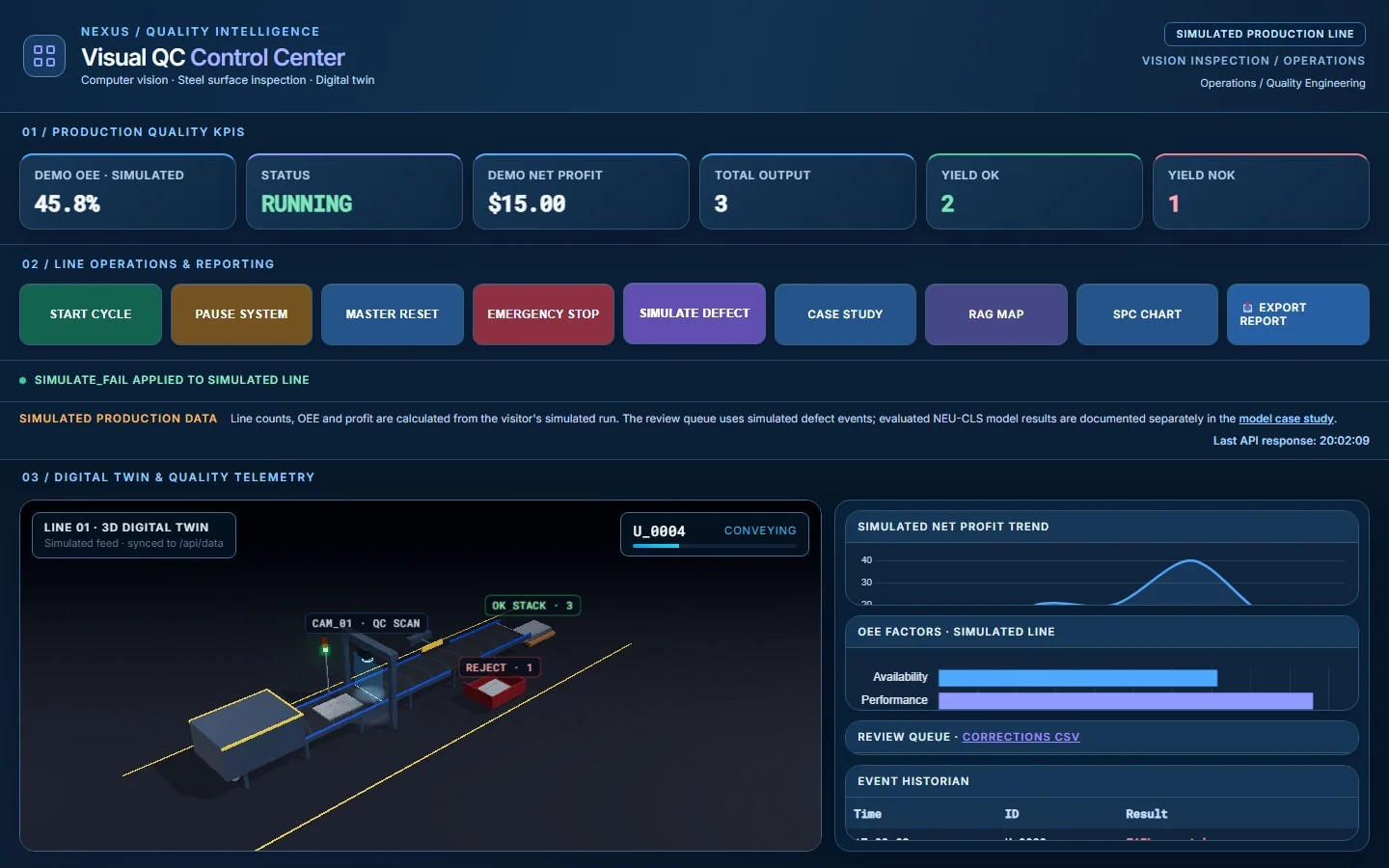
Dated demo screenshot
Public demonstration screenshot dated 2026-10-14; does not establish that the demo is currently online.
Open published source1,800 NEU-CLS images across 6 classes
0.9389 accuracy / 0.9392 macro F1
Top 20% review queue captures 81.8% of errors
Project proof
Last verified 2026-10-05
dashboard proof
Live HMI with 3D line twin
dashboard proof
RAG map
dashboard proof
SPC p-chart
dashboard proof
In-browser ResNet-18 demo (Hugging Face Space)
repo proof
Repository
document proof
RAG case study
document proof
Kaggle notebook: 100% accuracy and where it ends
document proof
ResNet-18 model card on Hugging Face
Problem and approach
Aggregate accuracy alone does not tell a quality team which defect classes fail most often or which uncertain cases should be reviewed first.
A deterministic 80/20 holdout evaluates HOG, Gabor, and grid features across baseline, Logistic Regression, and Random Forest models.
Prediction entropy ranks low-confidence cases so a limited human-review budget captures a disproportionate share of model errors.
BGE-base embeddings served from Chroma were chosen from a four-way retriever benchmark; a local Qwen2.5 generator and prompt were selected by NLI-measured faithfulness against a no-retrieval control.
It connects computer-vision evaluation, class-level error analysis, and a practical human-in-the-loop quality-review strategy.
Architecture and analysis
Testing and validation
Operational value
How to inspect