Problem
Maintenance teams need to prioritize limited inspection capacity without missing most of the rare machine-failure cases.
selected case study
A predictive-maintenance analytics case study on 10,000 AI4I records, combining EDA, engineered sensor signals, evaluated failure-risk scoring, DuckDB SQL, and a ranked maintenance queue — plus a second, genuine RUL-regression case study on NASA C-MAPSS turbofan data.
Quick technical review
Maintenance teams need to prioritize limited inspection capacity without missing most of the rare machine-failure cases.
The workflow combines AI4I EDA, cross-sensor feature engineering, benchmark models, tuned HistGradientBoosting evaluation, SHAP explainability, DuckDB SQL artifacts, and a Dockerized Flask review surface with CI-driven training, drift checks, and…
The workflow combines AI4I EDA, cross-sensor feature engineering, benchmark models, tuned HistGradientBoosting evaluation, SHAP explainability, DuckDB SQL artifacts, and a Dockerized Flask review surface with CI-driven training, drift checks, and Playwright E2E tests.
10,000 AI4I records
The 94.1% queue capture is measured on a 2,000-row holdout that contains 68 failures; across five splits PR-AUC is 0.880 plus or minus 0.032, so the single-split 0.9019 sits at the high end. The AI4I rows are simulated, the C-MAPSS result covers the…
The 94.1% queue capture is measured on a 2,000-row holdout that contains 68 failures; across five splits PR-AUC is 0.880 plus or minus 0.032, so the single-split 0.9019 sits at the high end. The AI4I rows are simulated, the C-MAPSS result covers the FD001 subset only, the live dashboard’s RUL tile is a simple heuristic derived from the AI4I risk score, and the drift check compares training rows against a synthetic shifted batch rather than a production sensor stream.
Summaries reuse the project’s documented evidence. Review the complete case study for evaluation boundaries.
Evidence-led visual review
Actual project screenshots and repository figures are shown with source provenance.
Dated demo screenshot
Public demonstration screenshot dated 2026-10-14; does not establish that the demo is currently online.
Open published source10,000 AI4I records
0.9874 ROC-AUC / 0.9019 PR-AUC
0.8293 F1 · C-MAPSS RUL RMSE 18.05 cycles
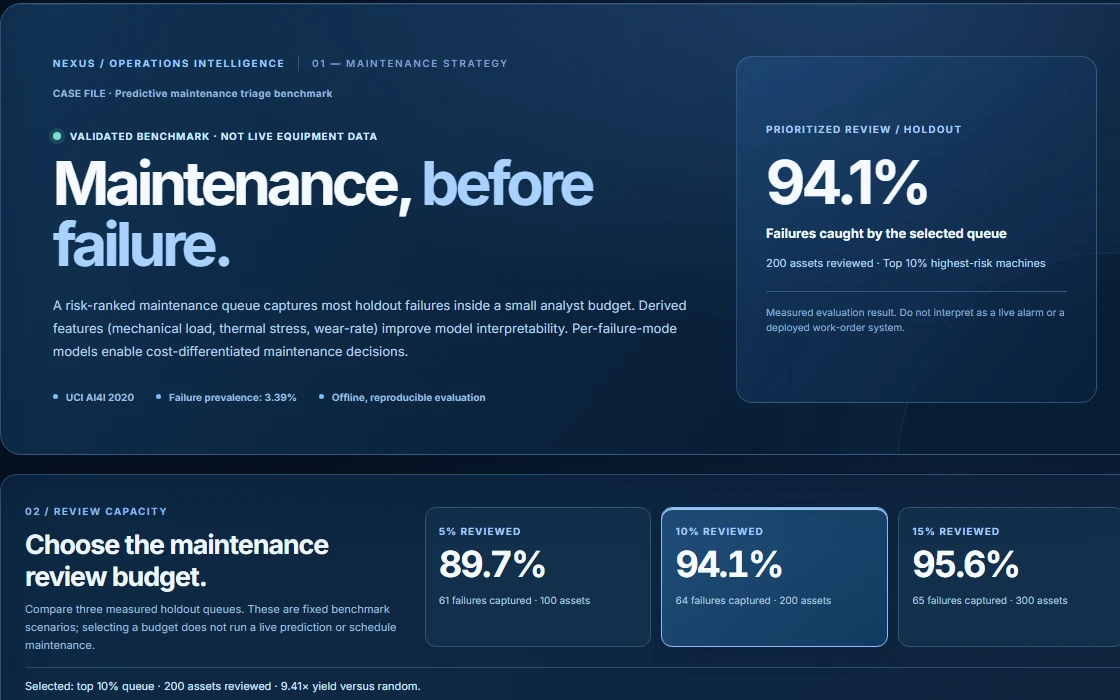
Top 10% queue captures 94.1% of failures at 9.4x lift
Project proof
Last verified 2026-10-05
Problem and approach
Maintenance teams need to prioritize limited inspection capacity without missing most of the rare machine-failure cases.
The workflow combines AI4I EDA, cross-sensor feature engineering, benchmark models, tuned HistGradientBoosting evaluation, SHAP explainability, DuckDB SQL artifacts, and a Dockerized Flask review surface with CI-driven training, drift checks, and Playwright E2E tests.
Failure probabilities rank assets for review, allowing the project to compare inspection budget, failure capture, and lift over random selection.
The 94.1% queue capture is measured on a 2,000-row holdout that contains 68 failures; across five splits PR-AUC is 0.880 plus or minus 0.032, so the single-split 0.9019 sits at the high end. The AI4I rows are simulated, the C-MAPSS result covers the FD001 subset only, the live dashboard’s RUL tile is a simple heuristic derived from the AI4I risk score, and the drift check compares training rows against a synthetic shifted batch rather than a production sensor stream.
It demonstrates how industrial context, imbalanced-classification evaluation, and operational queue design can work in one applied data-science case study — and pairs it with a second case study (C-MAPSS) that shows the same rigor applied where grouped, time-aware validation is actually possible.
Architecture and analysis
Testing and validation
Operational value
How to inspect